Thursday, September 30, 2010

No ‘Rime’ or Reason to Impatient Mariners
After leading the team to a surprising 85-win season last year, the last place Mariners fire manager Don Wakamatsu.


Don Wakamatsu talks to his players during Spring training at Camelback Ranch in Glendale, Arizona during his first season as manager of the Seattle Mariners. On Monday, Wakamatsu was fired after the team floundered to a 42-70 record in his second season at the helm. (MIKEY HIRANO CULROSS/Rafu Shimpo)

By JORDAN IKEDA

Rafu Sports Editor

The hits keep coming for the Japanese/Japanese American MLB community—only they aren’t the ones needed to win ballgames.

Monday, Seattle Mariners manager Don Wakamatsu along with bench coach Ty Van Burkleo and pitching coach Rick Adair, were given the boot as the scapegoats for a season lost to unrealistic expectations, injuries, and the curious inability to score any runs.

After helping to turn around a franchise-worst 61 wins into an 85-win campaign in his first year, Wakamatsu leaves the Mariners at the same low point he joined them, dead last in the American League West with a 42-70 record—or, more specifically, on pace to win 61 games.

“I have concluded that these changes needed to be made now and that they are in the best interest of the Mariners as we move forward,” general manager Jack Zduriencik said Monday.

“Don, Ty and Rick are all good baseball men and they have done their very best. But we are where we are. I no longer have confidence [they] are the right long-term fit for our organization. New leadership is needed and it is needed now.”

Ironic the choice of words Zduriencik used. “We are what we are.”

The Mariners were terrible offensively last year. They scored 640 runs, the worst mark in the AL, matched by their AL-worst OPS, and their bottom four finishes in batting average, RBI, and homeruns. While fantastic defensively thanks to solid glovework and a pitching staff that posted the league’s best ERA and WHIP, the Mariners’ 85 wins was extremely fluky seeing as how they were outscored by 52 runs over the course of the season.

That’s what the Mariners were and continue to be. A team rooted in defense and pitching that has absolutely no punch in the middle of the lineup.

The Mariners are currently dead last in the entire MLB in runs per game with a paltry 3.25, more than .25 runs less than the next worst team, as well as dead last in homeruns. The two highest batting averages on the roster are the two players at the top of the order. Ichiro Suzuki leads the team in average, while Figgins comes in second with at .254. Yes, .254.

What’s even more incredible is that Ichiro’s .753 OPS leads the team! That means the Mariners best power threat is its leadoff hitter. As a squad, the Mariners are hitting a whopping .236 with 67 total longballs and have no one, outside of Russell Branyan (signed a few weeks ago), that has ever hit 20 homeruns in more than one season. Branyan, the cleanup hitter, is hitting .200 with four home runs, and the No. 3 hitter, Casey Kotchman, is hitting just .215 with seven home runs.

This is the squad that Zduriencik put together.

Of course, coming into spring training, everything was supposed to be different. A lot of pundits had the Mariners pegged as the odds-on-favorite to win the AL West (this writer included) what with the Angels getting weaker and none of the other teams making any big moves. Zduriencik pushed his chips all in, trading away promising pitcher Brandon Morrow for hard-throwing reliever Brandon League, trading for 2008 Cy Young-award winner Cliff Lee, and signing speedster Chone Figgins, talented headcase Milton Bradley and defensive whiz Kotchman.

While those were upgrades at certain positions, the bottom line remains that he failed to address the squad’s most glaring need—power.

Everything went south as soon as spring training ended, as Lee missed the first month and a half due to an abdominal injury, Figgins struggled to adjust to life in the two hole, and Bradley was forced to spend time away from the team due to personal problems.

Then “NapGate” happened.

One of the reasons, cited by Wakamatsu himself, that the team was so successful last year was the leadership that first ballot Hall of Famer Ken Griffey Junior added to the clubhouse. This year, for whatever reason, old age, lack of motivation, discontentment, Junior couldn’t cut it. When it was released in the news that he had missed a possible pinch-hit situation because he was sleeping in the clubhouse, rumors of his dissatisfaction with Wakamatsu ran rampant. This despite Wakamatsu’s best efforts to get him in the lineup, every which way possible. Griffey hit .184 with a .454 OPS and ended up retiring quietly.

To make matters worse, two weeks ago, Figgins got into a physical confrontation with Wakamatsu over being benched, and veteran Mike Sweeney (who was ironically brought in to help stabilize the fractured clubhouse and is now with the Phillies) vocalized his displeasure and purposefully neglected to defend his manager.

To add to the futility, Ichiro had the worst month of his career, hitting .246 with a .548 OPS, a problem Wakamatsu speculated (in my mind, rightfully so) was rooted in the fact that teams were not afraid to walk him.

“I think if you have a real productive lineup,” Wakamatsu said last week, “or somebody that they’re worried about, all of a sudden it’s a two-run home run or a three-run home run, I think that’s as much of a factor. But if you walk in that situation, where you’re not intimidated maybe by the meat of the order then I think that’s the case, yeah, where they’re going to pitch him a little bit tougher.’’

The Mariners just wrapped up tying the worst month-ever in franchise history with a 6-22 mark. During that span, they hit .219 while the opposition hit .285. The pitching staff held a 4.54 ERA, but the offense only managed 2.7 runs per game. The team could’ve been pitching with a 3.00 ERA and still lost most of its games.

So, here’s the Mariners reasoning behind canning Wakamatsu in a nutshell: managed the league’s worst offensive team; compiled the league’s second worst record; on pace to tie franchise worst season; just tied worst month in franchise history; had physical confrontation with big offseason acquisition; mishandled swan-song season of most beloved player in franchise history; and lost the clubhouse to outspoken, misguided veterans.

Looked at that way, sure, Wakamatsu had to go.

Of course, looked at a bit differently: the fact that last year should have been Griffey’s swansong; that the manager doesn’t trade players or bring in highly opinionated veterans; that the offense actually lost power hitters from last season when it had one of the least productive lineups in the league; the fact that the star pitcher was injured for the first part of the season; and the fact that instead of adding a power bat when the team struggled early, the team instead fired then hitting coach Alan Cockrell, setting up what is turning into a habit of blame-shifting even at that early juncture in the season.

Add all that up, and it sure does appear that the Mariners former coaching staff was used as the scapegoats for mismanagement at the “general” level.

Solid future planning was uprooted after the excitement last season generated and impatience filled every aspect of what should have continued to be a rebuilding process.

In the end, Wakamatsu took the fall, despite helping to lead the M’s out of the cold wastelands of last place. Going forward, it will be interesting to see how the winds of change continue to dictate the feelings of the Mariners’ faithful.

Regardless, Wakamatsu by all accounts is a solid manager. His laidback approach and attention to defense and pitching are sure to land him another MLB gig in the future. Whether that’s sooner or later is yet to be determined.

After two years at the Big League level, seeing both the highs and lows of the business and how quickly praise can be turned into condemnation, regardless, on the morrow, Wakamatsu will be a “sadder” yet certainly “wiser man.”

Rock Solid Foundation


Clink on title for original link to Rafu Shimpo
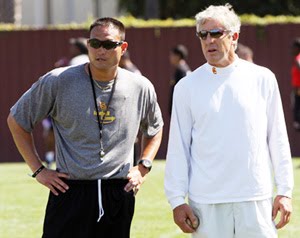
As he embarks on a new NFL career, Haruki Rocky Seto continues to be himself.

By JORDAN IKEDA/SPORTS EDITOR &

TREVOR WONG/STAFF WRITER

When the Rafu sat down to interview Haruki “Rocky” Seto in late July out in the San Gabriel Valley, before the first question had escaped our lips, he simply asked if we could pray. Actually, it was more of a statement than a request, but done in such a confident and unassuming manner that we indeed began the interview in prayer.

This, at the heart, is who Rocky Seto is.

A man of God.

He could surely be defined in many other ways. Nisei. Former USC Trojans linebacker. Father of three kids. Football coach.

But he wasn’t just any coach – he was a coach under the leadership of coach Pete Carroll, who helped shape arguably the greatest college football dynasty ever, winning seven straight Pac-10 championships, a record three consecutive Rose Bowl wins and five BCS bowl games. He is a champion, a leader and a former USC defensive coordinator. But tomorrow, in the Mile High City, he’ll be roaming the sidelines for the Seattle Seahawks with a brand new title: NFL assistant coach.

Spend a couple minutes with the man, and you’ll come away seeing him through a different lens. He is easy-going, with a hint of what might be mistaken for a Hawaiian accent, using words like “dude,” and “cool,” Seto exudes confidence while effortlessly remaining humble.

And despite the success he has achieved through football, and despite the fact he has enjoyed and continues to enjoy every minute of his job—the struggles, the wins, the practices, the travel and the players—none of it has come to define who he is as a person.

“With identity, sometimes, you get pushed into certain things that logically fit,” Seto said. “Being a Christian, that’s freed me up from a lot of stuff. You go off of what God calls you to do.”

Born to hard-working Issei parents, Seto grew up in Boyle Heights. Like most Japanese-American (JA) kids raised in Los Angeles during the ‘70s and early ‘80s, Seto adopted his father’s love of John Wooden basketball and John McKay football. On occasion, his father attended USC football games and would later describe to him O.J. Simpson in his glory days. It was from these moments with his dad, that his love of football blossomed into the aim of wearing the Cardinal and Gold.

His family moved to Monterey Park and then to Arcadia where he went to school and played football. After high school, Seto was not “physically or mentally ready” for USC so he opted to attend Mt. San Antonio Community College. His reasoning was simple – the head football coach at Mt. Sac, Bill Fisk, had been an All-American at USC three decades earlier, and that proximity, no matter how marginal, kept alive his dream of playing for USC football.

Three years later, after waiting nearly the entire summer to hear back from USC about walking onto the team, Seto took a leap of faith. He drove out to the campus, entered Heritage Hall, walked amidst the rows of bronze-casted Heisman Trophies and gleaming National Championship trophies, and sought out former coach John Robinson.

“He invited me into his office when I told him that I wanted to play,” Seto said. “He listened to me, then tossed me a notepad. I wrote down my information and a couple weeks later, I got a letter that told me to report to training camp.”


Seto spent 11 seasons working with Pete Carroll at USC and has continued on with Carroll on the Seahawks' staff.
“It’s unbelievable how it happened.”

Seto made the team as a walk-on, though it wasn’t without serious concerns from his parents whose Issei thinking had them struggling with the idea of him playing football. Undeterred, he pressed on and through his perseverance, eventually earned a scholarship during his senior year.

“That scholarship was a huge moment for our family and not just for the financial reasons,” Seto said, emotions causing him, for the first time during the interview, to falter to find the right words. “My father…he literally told me that I made him believe in the impossible.”

That belief was tested again when Seto declined to get his doctorate in physical therapy and instead felt called to coach. His parents just couldn’t understand this line of thinking. Coaching was such a foreign notion to them.

Seto joined the USC coaching staff in 1999 as an unpaid volunteer assistant under then—head coach Paul Hackett, where he worked with the defense and special teams.

“You can see these things where God was leading me in a certain way,” Seto said. “I could see how God was using football to keep me on course. I just wanted to play and I wanted to coach.”

A year later, he was upgraded to an administrative graduate assistant where he would do anything and everything to help out whether it be paperwork, cleaning, putting together scouting reports, getting lunch.

“It was good because it taught me to serve,” Seto said without an ounce of irony in his voice. “As you grow in your profession, as you grow in leadership, I think it’s important that you learn how to become a good follower, so that you are able to meet and understand the needs of the guys that are following you.”

He also learned the tenuous nature of coaching, when he, Hackett and the rest of the staff were let go before the start of the 2001 season. Based on a chance meeting at a USC volleyball game Seto had only attended to impress his then girlfriend (now wife) Sharla, he saw then-newly hired coach Pete Carroll in the stands. Seto introduced himself, talked with him and was offered the graduate assistant position.

A week after he accepted, Seto received a call from the Washington Redskins. One of his fellow coaches under Hackett wanted to know if he was interested in being the graduate assistant. From a purely professional perspective, this was a no-brainer.

He turned it down.

In explaining his decision, Seto references a verse in the book of Matthew in the Bible that states, “Let your yes be yes, and your no be no.” This same verse and the message behind it would play a major role in his decision four years down the road.

In the meantime, he worked two years as the USC graduate assistant, coaching the general defense in 2001 and safeties in 2002. In 2003 he became a full coach, in charge of safeties, and from 2004-2005 he coached linebackers.

Then, coming off a heart-breaking loss to Texas in the 2005 Rose Bowl, Seto was again offered an NFL job. This time, the Buffalo Bills were interested. He flew into Buffalo, aced a four-hour interview conducted by the general manager, head coach, and the defensive coordinator, and was offered the linebackers job right on the spot.

But, it was his wife who gently reminded him of a promise he had made to one of his players at USC, who had asked him if he would leave the team if he was offered an NFL job. Never thinking he would actually get an NFL gig, Seto told the player that all he needed to worry about was football, that he would indeed be back the following year as coach.

“We prayed about it and we decided to stay,” Seto said. “As we have grown older and closer to Jesus Christ, our priorities became a lot clearer. It’s always what’s pleasing to God first, then what’s best for our marriage, then our children, then what’s best for our work … in that order. It didn’t even get past priority number one.”

Another offer, this one to be the defensive coordinator for Steve Sarkisian at the University of Washington, came down to a family decision and was aided with a little advice from John Wooden, who asked Seto if he was happy.

“I was extremely happy,” Seto said. “Coaching at USC was my dream and my family was well taken care of. Plus, California was my home. And I could hear in his voice like he was almost saying, ‘Then what’s the problem?’”

So, Seto continued to live his dream. He coached the secondary for a couple years and last year, he was promoted to be the defensive coordinator. But sometimes living a dream is not all its cracked up to be. Last season didn’t exactly live up to USC football standards—the Trojans finished 9-4, fell short of a Pac-10 title and didn’t qualify for a meaningful bowl game. Furthermore, there were whispers that it was the Trojan defense that lost a few of the closer games.

To top it all off, Carroll left USC for the NFL, the coaching staff was overhauled and the NCAA imposed sanctions on the football program including a bowl ban for two years and stripping former running back, Reggie Bush, of his Heisman Trophy.

“It makes us appear like we were cheating throughout the whole time and it’s sad because that’s not the case,” Seto said. “We weren’t paying the players, getting the parents paid. It’s very, very unfortunate to coach Carroll, the staff and the players for all the hard work that was put in. It puts a negative tone on it. Nonetheless, I was there, coach Carroll was there and it is our responsibility on how things turned out. Unfortunately, all these things that happened…we weren’t able to keep them from happening.”

Despite all this, Seto never regretted his decision in deciding to stay at USC. And despite uncertainty for the future, he never worried, nor wavered in his faith that has helped shape his identity.

“The perception is that we cheated,” he said. “Me too … I was there for 13 years. But perception is a thing you can never control and you should never live for. It’s who you are before God that is the most important thing.

“I believe the more you focus on who you are, perception will take care of itself. And even if it doesn’t, I’m at peace with who I am. Just like this whole probation thing, the perception is very negative. I feel saddened by what’s happened, but for me, because I only answer to God, I feel okay with it.”

Seto explained how fleeting things are—how Heisman Trophies and national championships can disappear as quickly as momentum after a goal-line fumble. He talked about finding peace concerning not coaching after he left USC. He also talked about finally joining the NFL after turning it down twice before.

In January, Carroll brought Seto onboard with the Seahawks as the defensive quality control coach. Now, Seto and his family live two minutes away from where his wife was born and raised. He’s coaching three of his former players, Lofa Tatupu, Mike Williams and Anthony McCoy. And he’s helping to build up a team that has been languishing at the bottom of the NFC for the past several seasons.

Last year, Seattle was one of the worst defensive teams in the NFL.

Last week, they dismantled the 49ers, holding San Francisco to six points.

“The goals remain the same here,” Seto said. “Maximize our team and the team we have right now. The goal, even back at SC, was never to win championships. We never talked that way. The goal was to see how good we could be. To see how far we could go if we maximized ourselves.”

Seto has come a long way since that first time he set foot in Heritage Hall. Never worrying about results whether it be in football or in life, through the highs of championships, to the lows of sanctions, through all of the uncertainty, he has remained certain in his identity.

“God allowed me to experience a lot [at USC],” Seto said. “Those championships were fun, they are life-long memories and they were tremendous. But what’s sold out in the media is the championships, the money and the fame. All those things are really promoted, celebrated and really worshipped—but in the end, if you put your hope in these things, they will disappoint you.”

Seto understands where his identity lies, where his foundation is firmly planted. And he wholly embraces it.

“This is how I am,” he said. “I don’t know how to not be myself. In coaching or anything else, it’s important to be who you are.”

Friday, September 3, 2010

Jeremy Lin-spiration


Suicide lines: Jeremy Lin-spiration; Granger's step back

By Trey Kerby

Each weekday morning, BDL serves up a handful of NBA-related stories to digest with your biscuits and honey.

Kevin Ding, Orange County Register: Before change comes inspiration. Before inspiration, someone must inspire. Here is Jeremy Lin(notes). Even if in his own mind he's merely just another American kid playing ball, here is Jeremy Lin. He's a somewhat reluctant torch-bearer for race. He has not even begun his NBA career and is trying to pursue his dream his way. His reservations are completely understandable - yet altogether secondary to the greater good. He is already someone to so many, and that's the thing about inspiration: It's not about the one causing the inspiration as much as it's about the effect on many. Quick summary of Lin's recent months: unwanted in the June NBA draft, fortunate to have one offer to take part in NBA summer-league play, absolutely captivating against No. 1 overall pick John Wall(notes) in a televised head-to-head matchup and suddenly in position to turn away teams such as the Lakers to accept an offer from his hometown Golden State Warriors for a partially guaranteed contract that half the guys who were drafted couldn't get. Lin will be in the NBA this season. He is not a pioneer, technically: The NBA is unsure of its exact track record, but Japanese-American Wat Misaka was the league's first non-Caucasian player way back in 1947. Raymond Townsend and Rex Walters followed more recently, their stories begun when born to Asian mothers but hard to read from their bi-racial faces. What people see when they look at Lin's face is clear. Asian publications based in New York, Boston and Washington recently dispatched reporters to San Francisco just because Lin was giving a 5-minute speech to a group of basketball campers. What was said to Lin's face by heckling opposing fans during his four years at Harvard was also clear. For the closed-minded, nothing is more frightening than a true game-changer - and Lin has had to carry that burden. Yes, he went to Harvard; no one offered an athletic scholarship despite Lin being a legit 6-foot-3 and honored as the California prep player of the year. He will be Harvard's first NBA player in nearly 50 years. He posted a 3.1 grade-point average while there and has his degree in economics, thank you very much. There's no doubt that among the inspired now are Lin's fellow academics who can only dream of the cool points of being a professional athlete. But any Ivy League grad torn between risking financial insecurity and pursuit of a less conventional dream should be finding inspiration in Lin, too.

Lin is the NBA's Asian-American inspiration
By KEVIN DING
By KEVIN DING
THE ORANGE COUNTY REGISTER
kding@ocregister.com
Story Highlights

Kevin Ding column: The story of Jeremy Lin becoming a rare Asian-American to make the NBA -- his whirlwind summer included spurning the Lakers -- is an inspiration before Lin even plays his first minute with his hometown Golden State Warriors.


Before change comes inspiration.

Before inspiration, someone must inspire.
Article Tab : rookie-golden-achievement
Golden State Warriors rookie Jeremy Lin appeared in Taipei, Taiwan, on July 28 to commemorate his achievement as the first Taiwanese-American to reach the NBA. Click on the link for more photos of Lin.
WALLY SANTANA, AP

Here is Jeremy Lin. Even if in his own mind he's merely just another American kid playing ball, here is Jeremy Lin.

He's a somewhat reluctant torch-bearer for race. He has not even begun his NBA career and is trying to pursue his dream his way. His reservations are completely understandable – yet altogether secondary to the greater good.

He is already someone to so many, and that's the thing about inspiration: It's not about the one causing the inspiration as much as it's about the effect on many.

Quick summary of Lin's recent months: unwanted in the June NBA draft, fortunate to have one offer to take part in NBA summer-league play, absolutely captivating against No. 1 overall pick John Wall in a televised head-to-head matchup and suddenly in position to turn away teams such as the Lakers to accept an offer from his hometown Golden State Warriors for a partially guaranteed contract that half the guys who were drafted couldn't get.

Lin will be in the NBA this season. He is not a pioneer, technically: The NBA is unsure of its exact track record, but Japanese-American Wat Misaka was the league's first non-Caucasian player way back in 1947. Raymond Townsend and Rex Walters followed more recently, their stories begun when born to Asian mothers but hard to read from their bi-racial faces.

What people see when they look at Lin's face is clear. Asian publications based in New York, Boston and Washington recently dispatched reporters to San Francisco just because Lin was giving a 5-minute speech to a group of basketball campers.

What was said to Lin's face by heckling opposing fans during his four years at Harvard was also clear. For the closed-minded, nothing is more frightening than a true game-changer – and Lin has had to carry that burden.

Yes, he went to Harvard; no one offered an athletic scholarship despite Lin being a legit 6-foot-3 and honored as the California prep player of the year. He will be Harvard's first NBA player in nearly 50 years. He posted a 3.1 grade-point average while there and has his degree in economics, thank you very much.

There's no doubt that among the inspired now are Lin's fellow academics who can only dream of the cool points of being a professional athlete. But any Ivy League grad torn between risking financial insecurity and pursuit of a less conventional dream should be finding inspiration in Lin, too.

He has stayed determined to keep playing basketball despite all obstacles. And now he's a study of American society in so many ways, another being religion because Lin has spoken of his interest in the ministry.

Race, religion, education ... these are the pillars of the house in which we all live together. In his own head, Lin feels like another 22-year-old dude playing Halo on his Xbox. In reality, he's everybody's documentary.

Time Magazine featured Lin in December. CNN did an extended interview with him in August. The New York Times just wrote 1,000 words about him.

Lin's parents came from Taiwan to the U.S., and they embraced the freedom – including Jeremy's computer-engineer father, Gie-Ming, ardently supporting his sons in basketball with the all-American spirit of doing what you are good at and love. That's a stark contrast to typical Asian immigrant parents intent on producing valedictorians who become doctors – or if it must be athletics, perhaps tennis players or figure skaters.

This is another way Lin stands to initiate change here far more than someone like Yao Ming, whose people rushed to capitalize on Lin's emergence with a last-minute invitation to Yao's annual charity game in Taiwan. The reality is that Lin has almost nothing in common with Yao, a 7-foot-5 freak who was born into and groomed through China's communist sports system to be what he became: a basketball Ivan Drago.

That would mean Lin is Rocky Balboa or any other classic underdog. He already lived through his own "Hoosiers" movie by shockingly slaying the mighty Mater Dei Monarchs in the 2006 Division II state championship game.

These days, Lin is largely secluded in the Warriors' practice gym, trying to make up for working harder as a pre-teen playing pickup games against grown men than in structured team practices. He knows he still has much to prove.

Is his 5-on-5 court savvy that didn't come through in individual pre-draft workouts truly that unique? Can he really flash off picks and attack the rim with a fearless burst reminiscent of Dwyane Wade? Will he develop his jumper into a consistent 3-point shot?

If so, he earns the Warriors' backup point-guard job this season, that Asian-American face becomes a lasting image in this place where they say amazing happens, and the inspiration grows.

But make no mistake: Something has already changed.

Someone has made it ... and made it change.

Wednesday, August 25, 2010

Japanese Heritage Night II at AT&T Park


Special Edition Masanori Murakami Jersey T
A very rare warm night baseball game at AT&T in which you could actually wear shorts and t shirt and not be freezing cold

Friday, August 20, 2010

Jeremy Lin, Instant Sports Celebrity in Taiwan

Here is a link to some Jeremy Lin stuff, alot of video from taiwan game

Jeremy Lin, Instant Sports Celebrity in Taiwan

By John | Monday, August 2, 2010 | 1 Comment and 0 Reactions

Kenichi Zenimura, the Father of Japanese-American Baseball


Kenichi Zenimura is in between Lou Gehrig and Babe Ruth, in 1927


Kenichi Zenimura, the Father of Japanese-American Baseball
By daigo | Published: Wednesday, July 7, 2010


Nisei Baseball Research Project has started its campain to nominate Kenichi Zenimura, the Father of Japanese American Baseball, for the National Baseball Hall of Fame Buck O’Neil Lifetime Achievement Award. (Press Reliese about nominations being accepted)

Nominations for the award must be submitted via standard U.S. mail, and electronic submissions are not accepted. So, Nisei Baseball Research Project have a letter that you can just download, print, sign and send with a stamp.

I just sent in mine today.

Zenimura, an issei who was born in Hiroshima, was the driving force of Japanese-American baseball in the time of World War II. Here is a link to very nice story abot Zenimura in mlb.com, by Stephen Ellsesser. Here is nice write up about how Nisei Baseball Research Project was started. Here is history of History of Nisei Leagues

Following is the quotes from NBRP’s nomination letter, which .

Top 10 Kenichi Zenimura Career Highlights for the Buck O’Neil Lifetime Achievement Award

1. A True Baseball Ambassador
Before, during and after WWII, Zenimura leveraged the game of baseball to break down barriers and build bridges between people of different racial, cultural and geographic backgrounds. In 2007, MLB.com called Zenimura “a true baseball ambassador,” showcasing his quote: “It is much easier to make efforts of starting a better understanding between us in the field of sports then trying to talk your way through rough spots.”
2. Bridge to the Pacific
Zenimura was a tireless exporter of the American style of baseball to Asia, including goodwill tours to Japan, Korea and China in 1924, 1927 and 1937. In fact, between 1923 and late-1931, no MLB team toured Japan. One reason was because of the thrown-game incident of 1922 when the MLB-stars lost 9-3 to a Japanese ballclub on purpose. “We welcomed the American team because we thought they were gentlemanly and sportsmanlike,” said the Japanese players. “They have now shown themselves to be full of the mean professional spirit …they disappointed our hopes and left an unpleasant impression upon us.” Zenimura, his Nisei peers, and Negro League counterparts stepped in and served as the U.S. baseball ambassadors during this eight-year MLB-team void.
3. Royal Giants’ 1927 Japan Tour
After the all-black Los Angeles White Sox were guests of Zenimura’s in Fresno during Fourth of July weekend 1926, he convinced manager Lon Goodwin to take his club on a tour of Japan. Goodwin changed his ballclub’s team name to the Philadelphia Royal Giants and departed for Japan in April 1927. Japanese author and historian Kazuo Sayama credits the 1927 tour, especially Biz Mackey and his gentlemanly teammates, for inspiring the start of professional baseball in Japan in 1936.
4. Babe Ruth’s 1934 Japan Tour
In October 1927 Zenimura was teammates with Lou Gehrig in an exhibition contest against Babe Ruth and a team of local all-stars. Several months after the game Zeni sent a copy his photo with the Yankee sluggers to his contacts in Japan. “I got a call from Japan to see if I could get Ruth to go to the Island and play for $40,000 guarantee,” said Zeni. “I contacted Ruth and he said he would go for $60,000. It was too much but a few years later (1934) he went (to Japan) and made a big hit.”5 Ruth’s visit is widely believed to have inspired the start of pro baseball in Japan in 1936 as well.
5. Breaking Down Barriers
“No Japs Wanted!” These were the words displayed on billboards in 1923 Livingston, CA. Zenimura and his team courageously “put together enough guts and made the trip – trying especially hard to play clean ball.” Zeni scheduled return games in Livingston and soon the signs disappeared. This event was one of the earliest known cases of Zeni using the game of baseball to transcend the ignorance and intolerance of his era.
6. Turning a Negative into a Positive
In 1924 Zenimura’s all-Japanese Fresno Athletic Club applied to join the newly formed San Joaquin Valley Baseball League. Before the season could start, the team from Porterville protested: “We don’t want the Japanese to play in Porterville … We have kept them out in other lines and if we let them come in baseball, they will bring a following and this we don’t want … This is a white man’s town and we intend to keep it as such.” Turning the negative into a positive, Zeni instead scheduled a three-game series against the Salt Lake City Bees of the Pacific Coast League. The FAC surprised everyone by taking one game 6-4. The series also marked the first time for Lefty O’Doul – future goodwill ambassador to Japan – to compete against players of Japanese ancestry.
7. Twilight League Leadership
Zenimura transcended the racial tensions of depression-era California by serving as player/manager of the predominately white Twilight Leagues in the 1930s. Twilight League teammate Don Jorgensen said of Zeni: “He was a little small, but real smart in baseball, real smart. He knew all the trick of the trade in baseball … He had my respect and he had the respect of all the ballplayers on his team.”
8. The Nisei-Negro Leagues Brotherhood
Japanese Americans and African-Americans shared a bond through their common struggle for equality. Throughout the 1920s and 30s Zeni scheduled numerous contests against west coast Negro League teams. In fact, Zenimura won 7 of 12 games against Negro League teams. And when the allblack squads were not competing against Zeni’s ballclub, they were welcomed guests at his Fresno Japanese Baseball Park. In fact, O’Neal Pullen, former Philadelphia Royal Giants catcher, leveraged his relationship with Zenimura to use the field as late as 1935 as player-manager of the Bakersfield Cubs.
9. From Internment to Hope
During WWII, Zenimura was one of 120,000 people of Japanese Ancestry sent to internment camps by the U.S. government. Behind barbed wire in Gila River, Arizona, Zeni constructed a ballfield and organized leagues that gave internees a sense of hope and normalcy. The late Pat Morita, actor and former Gila River internee, said of Zeni: “(He) showed that with effort and persistence, you can overcome the harshness of adversity … Zenimura and others created a fraternal community in the desert—and baseball was the glue.”
10. Little Man, Big Impact
During his four decades in baseball, Zenimura made a positive impact on the lives of thousands of players. Tets Furukawa, pitcher with the 1945 Butte High Eagles, captured the essence of Zenimura’s legacy best: “Coach Zeni … indeed possessed a tremendous knowledge of baseball savvy, but above all, he wanted every player to become a better human being by realizing his responsibility and compassion for his fellow man.”

References

1. “Baseball Czar K. Zenimura Gives Thanks and Regards,” Gila News Courier, August 1, 1945, Pg. 6
2. SABR Asian Baseball Committee, Japanese Baseball Page
3. “Big Leaguers Boot One in Japan, Herbert Hunter Takes Major League All-Stars to Japan,” Fresno Bee, December 14, 1922, pg. 9
4. David King, “Finally Getting His Due,” San Antonio Express-News, July 30, 2006, Pg. 01C
5. “Fresno’s Ken Zenimura, Dean of Nisei Baseball In US, Recalls Colorful Past,” Fresno Bee, May 20, 1962, pg. B-9
6. “New Ball Park at Livingston opened, Japanese defeated,” The Fresno Bee, May 1, 1923, pg. 12
7. “Editorial: Huge Signs Disappeared,” Gila News Courier, September 25, 1943, Pg. 6
8. ibid.
9. “Porterville Would Bar Japanese,” Fresno Bee, February 26, 1924, pg. 10
10. “Bees Wallop Japanese 15-2,” Fresno Bee, March 31, 1924, pg. 4
11. Documentary: Diamonds in the Rough: The Legacy of Japanese-American Baseball, Chip Taylor Productions, 1998
12. “Fourth of July Fette is Planned,” Fresno Bee, June 23, 1936, pg. 5B
13. “A Field In The Desert That Felt Like Home, An Unlikely Hero Sustained Hope For Japanese-Americans Interned In World War II,” Sports Illustrated, November 16, 1998, Pgs. 48-51
14. Tetsuo Furokawa, “When Gila Fought Heart Mountain,” National Japanese American Historical Society, Nikkei Heritage, Sports 2006, Pg. 11
15. Kerry Yo Nakagawa. Through a Diamond: 100 Years of Japanese American Baseball, (San Francisco: Rudi Publishing, 2001), foreword.

This entry was posted in Asian Issues, Baseball, Softball, and Judo. Bookmark the permalink. Trackbacks are closed, but you can post a comment.

Sunday, August 15, 2010

Seattle Mariners manager Don Wakamatsu relieved of his duties


Mariners fired manager Don Wakamatsu, Monday, Aug. 9, 2010.
Photo: Kevin P. Casey / AP


Manager firing, triple play make for wild M's day
By GREGG BELL, AP Sports Writer

Tuesday, August 10, 2010

More... (08-10) 00:07 PDT Seattle (AP) --

Don Wakamatsu, the major leagues' first Japanese-American manager, got fired by the Seattle Mariners hours before they hosted a Japanese heritage day celebration on their field.

As some of Seattle's more fed-up fans would say: Only the wayward Mariners.

A Monday that began with the last-place team canning Wakamatsu after one great season and about one half of a terrible one also included Seattle's first triple play in 15 years. That was in an oddly efficient, 3-1 win over playoff-contending Oakland.

Then 43-year-old interim manager Daren Brown, dazed from a lack of sleep following a short Sunday night managing Triple-A Tacoma and then a flight from Omaha, climbed into a laundry bin in Seattle and got rolled down a hallway by closer David Aardsma and into his first major-league beer shower.

Brown looked like an oversized baby in a stroller, smiling with his feet dangling over the front edge and arms over the sides.

He celebrated like a man who had finally made it to the big leagues after 1,485 games managing in the minors — and won.

"If I was going to sit down and draw it up, that's how I would have done it," Brown said in his Oklahoman drawl.

It's the first time something has gone according to plan in this wacky Mariners season, which has featured:

_ Wakamatsu benching storied slugger Ken Griffey Jr. because he was hitting .200 without a home run, and then the franchise icon angrily driving away to Florida — but not informing the Mariners he was retiring until he was hours into his drive, almost out of the state.

_ Outfielder Eric Byrnes inexplicably pulling his bat back on a suicide squeeze play to get a runner thrown out at home. A few minutes after that 2-0 loss in 12 innings to Texas, Byrnes drove out the clubhouse door on a beach cruiser bicycle and did a 90-degree left turn in a tunnel around startled general manager Jack Zduriencik. Byrnes was cut a few days later.

_ Wakamatsu taking mercurial slugger Milton Bradley out of a May game and sending him into the clubhouse because Bradley was irate for striking out. Bradley left the stadium during the game, and then got pulled over by a traffic cop for speeding on his way home. He came in the next day to ask Wakamatsu and Zduriencik for help with emotional issues. Bradley spent two weeks in counseling and on the restricted list.

_ Ace Cliff Lee, the prized winter acquisition and presumed piece that would get Seattle to its first postseason since 2001, missing the first month of the season following an unsuccessful attempt to heal his strained abdomen with unproven blood-spinning treatment. Lee returned to dominate, only to be traded to division-rival Texas last month when the Mariners fell so far out of the AL West race.

_ Chone Figgins, whom Zduriencik signed to a $36-million, free-agent contract last winter, repeatedly clashing with Wakamatsu. The last time resulted in an in-game dugout fracas. There was shouting, pushing, players trying to jump over others to fight, and infielder Jose Lopez getting his shirt pulled over his back — all in front of half the home stadium and a national television audience. Figgins never apologized.

Monday, when approached following Wakamatsu's firing, Figgins smiled, shook his head and politely said, "I'm not going to talk about it, man."

_ First baseman Russell Branyan, the lone consistent threat to hit a home run on the worst offensive team in baseball, injured his foot recently when a table in his hotel room fell on it as he was trying to close curtains.

_ And starting shortstop Jack Wilson slipped in his bathroom early Sunday and broke his right hand. He's headed to surgery Wednesday and is likely out for the season.

So of course Seattle would turn its first triple play since July 13, 1995, against Toronto, on the day they fired Wakamatsu. Lopez took a chopper by Oakland's Mark Ellis in the fourth inning Monday and immediately stepped on third base for a forceout. Lopez then threw to second base for a forceout there, and Figgins' throw to first baseman Casey Kotchman appeared to arrive at the same time as Ellis' foot hit the bag, but first base umpire Cory Blaser called Ellis out.

The 5-4-3 play was the 10th triple putout for the Mariners, who began play in 1977.

Brown got the game ball from center fielder Franklin Gutierrez, who caught the final out. It will be the first souvenir for Brown's new office. That room was empty after Wakamatsu was forced to clear it out.

Brown became the 10th of Seattle's 17 managers to win their first game. Only one of the other 16 finished their Mariners tenure with a winning record: Lou Piniella.

Ichiro Suzuki, Seattle's perennial All-Star and cornerstone, called Wakamatsu's firing "frustrating."

"It's not just his responsibility (that we're losing). It's the whole team's responsibility," Suzuki said through his interpreter. "I don't think it's fair to say the manager's responsible to take the blame, because he's not."

Suzuki sees his Mariners back at square one, less than 12 months after Wakamatsu finished a revitalizing, 85-win season.

"That's the only way we can look at it," Suzuki said.

Zduriencik disagreed.

"I don't think we are back to square zero," the GM said, fittingly going even lower. "However, this season presented an opportunity for us. In that opportunity, a lot of things had to fall into place — with the acquisition of Cliff Lee, with the addition of Chone Figgins, and players I thought had to have good seasons.

"To look around and see so many players having sub-par seasons is very disturbing."


Seattle Mariners manager Don Wakamatsu relieved of his duties; Bench coach Ty Van Burkleo and pitching coach Rich Adair also let go
08/09/2010 3:19 PM ET
MLB.com

SEATTLE, Wash. -- Seattle Mariners Executive Vice President & General Manager of Baseball Operations Jack Zduriencik announced today that Don Wakamatsu has been relieved of his duties as manager. Zduriencik met with Wakamatsu this morning and informed him of the decision. In addition, Zduriencik has replaced bench coach Ty Van Burkleo and pitching coach Rick Adair, and released performance coach Steve Hecht from his contract.
"I have concluded that these changes needed to be made now and that they are in the best interest of the Mariners as we move forward,"

Zduriencik said. "Don, Ty and Rick are all good baseball men and they have done their very best. But we are where we are. I no longer have confidence that Don, Ty and Rick are the right long-term fit for our organization. New leadership is needed and it is needed now."

Daren Brown, who has managed the Mariners AAA Tacoma Rainiers affiliate in the Pacific Coast League for the past four seasons, has been named interim manager for the remainder of the 2010 season. Roger Hansen, who had been the Mariners minor league catching coordinator, takes over as the bench coach. Carl Willis, who was the Mariners minor league pitching coordinator, takes on the responsibility of big league pitching coach.

"Daren is an experienced manager with over a decade of minor league managing experience. He is intimately familiar with our club; he was with the club in Spring Training and managed many of the players on our current roster in the minors. I believe he will do a fine job," Zduriencik said.

Brown, 43, spent the past three Septembers as a coach with the Mariners. He has extensive minor league managing experience, with a career mark of 794-691 (.535). The Rainiers are currently atop the PCL North Division with a 61-54 mark. Tacoma also won the PCL North Division Title in 2009. Brown has managed in the Mariners system since 2001: at Tacoma (2007-2010), AA San Antonio (2006), High A Inland Empire (2004-2005), A Wisconsin (2003) and High A San Bernardino (2001-2002). Brown spent the 1994-2000 seasons with the independent league Amarillo (TX) Dillas. He was the team's manager from 1998-2000, compiling a 203-77 (.725) record, and won the Texas-Louisiana League Title in 1999. Brown was the pitching coach from 1994-97, and pitched for the team from 1994-1999, compiling a 60-24 record as a starting pitcher.

Brown spent five seasons (1989-1993) pitching in the Toronto Blue Jays minor league system, reaching AA in his final two years. He finished his minor league career with a 90-49 mark. Brown graduated from Southeastern Oklahoma State in 1994. His father, Paul, pitched for the Philadelphia Phillies from 1961-63 and 1967.

New bench coach Roger Hansen spent the past eight seasons as the Mariners minor league catching coordinator. He was the Mariners bullpen coach in 1992 and, at the time, was the youngest coach in the Majors. He also spent two seasons as a roving catching instructor with the Orix Blue Wave in Japan. Hansen spent 10 seasons in the minors as a player, including three years (1987-89) bouncing between AA and AAA in the Seattle system.

New pitching coach Carl Willis was in his first season as the Mariners minor league pitching coordinator. He spent the last seven seasons (2003-2009) as the Cleveland Indians Major League pitching coach. During his tenure, the Indians staff consistently ranked among the best in the American League, including ranking in the top-six in starters ERA in six seasons. He was pitching coach for CC Sabathia (2007) and Cliff Lee (2008) during their back-to-back Cy Young Award seasons. Willis pitched the Majors during parts of 12 seasons with Detroit (1983-84), Cincinnati (1984-87), Chicago (AL, 1988-91) and Minnesota (1992-95). He was a member of two World Series winners, with the Tigers in 1984 and the Twins in 1991.

Wakamatsu, 47, was named manager of the Mariners on Nov. 19, 2008. He posted an 85-77 mark during the 2009 season. The Mariners are 42-70 this year. Van Burkleo and Adair were part of his original staff in 2009.

"We want to thank Don, Ty and Rick for their service," Zduriencik added. "We appreciate their efforts and wish them all the best in the future."

For more information, please contact the Seattle Mariners baseball information department at (206) 346-4000. More information on Seattle's roster is also available online at www.mariners.com or www.losmarineros.com.

This story was not subject to the approval of Major League Baseball or its clubs.